Monday, February 8, 2016

Dillon RL550B and First Sunday Match.


I have had this thing for several months now and I am finally getting it installed for use. Way back, I broke the particle board work bench top with normal press operation.


Even when I put it there, I knew it was just a matter of time until it would give.

I cleaned up the damage as best I could and put a piece of 3/4" birch plywood on the top of the bench, glued down and backed up with a metal plate underneath.


One the front edge, where the damage was most severe, I also sandwiched the damaged particle board with a strip of plywood underneath.


This has all served really well, the press was now mounted solidly enough to reveal other problems instead :)

Enter the Dillon.

The Dillon has the strong mount accessory base that is wider than the piece of plywood that I bolstered the workbench with. It solves problems with some installations, but it may not be the best solution for my installation, due largely to my relatively high benchtop.

My original plan was to add a strip of 3/4" plywood to make it a little wider to fit the Dillon. I decided that I didn't really want to piece it together like that and thought I should just cut bigger piece of plywood. I have a piece of exterior grade plywood I purchased but turned out not to need for a ham radio project.

Then I realized that the whole workbench could benefit from a plywood top. I have a bench vise on the other end of that work area. That plywood piece I have is solid, other than the holes drilled in it, but it's kinda rough. I remembered a plywood table/bench top I made long ago that was not friendly to skin.

I then decided that if I was gonna do the whole surface, it would be worth getting a nice piece of plywood for it, so I verified that a 2x4 foot piece would fit and I went to Lowe's for plywood, hardware and Liquid Nails adhesive.

By then, it was time to get ready for my attendance of the first official 1st Sunday IDPA match and I didn't want to fix the workbench right then as badly as I wanted to go shoot!

Matchwise, because of the troubles I was having with the Remington primers in the Starline brass, I didn't trust my last batch of ammo and shot with Remington UMC factory ammo. I brought a 10mm Auto barrel and some ammo for it, but elected to go with the 40S&W.

Stage 1 hurt but the rest of my stages were reasonably good, especially considering that it has been a couple of months by now since my last match. The majority of the pain was from one target. It was at the far left of the range, kinda in the dark, a vertical target with an angled non-threat in front of it. Not only did I hit the non-threat, but I aimed at the non-threat and having missed it, made up the shot. The actual target was clean. So, 10 down plus 5 seconds fail to neutralize on the target and not one, but two hits on the non-threat for 10 more seconds. I'm pretty sure there was another procedural as well, out of cover for another target. The rest of the stage was pretty normal, 1's and 3's.

The rest of the stages weren't bad either. Overall, raw time 109.59, total 142.09. Stage 1 points down and penalties accounted for 22 seconds alone.


Wednesday, November 11, 2015

BUG/CCP Match and Ammo Talk


Well, the BladeTech Southern Regional BUG / CCP Match held last Saturday was great fun! It had rained Friday and overnight Friday night. The rain was pretty much gone by match time Saturday morning, but it was still vera muddy.


I was my own worst enemy when it came to arriving on time. I left the house plenty early, but 20 minutes down the road, noticed I had left my wallet at home. So, 40 minutes added to trip. Caught at the railroad crossing on the way out the second time, so 5 more minutes there, though it always feels longer. Then as I neared the range, I lefted when I should have righted and didn't realize *that* for 15 minutes, so 15 extra minutes added. I arrived at the gate shortly after the shooter's meeting, and the range is still 15 minutes from the gate. Still, I got there, parked, registered and caught up with my squad and got inspection and stage description before the first shot, so not bad...

Two stages kind ate me up. The first was simply a matter of shooting faster than I can go. It looks good on the video but the score was pretty poor, 25 down on that one stage. One other stage had a poor score. Those two account for 2/3 of my total penalties. In contrast, the other 10 stages averaged 3 down.

Still, it was fun and I had almost no ammo issues. All rounds that saw the firing pin fired. I did have two rounds that failed to go into battery. I have gotten into what could arguably be a bad habit of racking out such failures. I think I need to develop instead the habit of bumping the back of the slide to attempt to force them into battery. With a BUG pistol at a BUG match, the stages were understandably BUG friendly, designed largely to be shot in groups of 6. Two targets get 3 each or 3 targets to two each, then move. Well, when you rack out a fail to battery, you now have only 5 rounds. You will run out before you address all 6 rounds. So, advance to cover, reload, take the last shot. *Now*, you're probably going be short for the next 6 rounds and have to stop and reload for that. Both rounds that were racked out were lost in the copious mud, so I could not check those to see if there was a dimensional issue with them.

All in all, however, it was a fun match with ammo I feel I can trust, at least for competition. This Thursday, I may get to test that load in the Glock, though Thursday is also the last day of work for my retiring spouse. I might be busy. :)


Friday, November 6, 2015

It's Not Really Science If You Change All The Conditions


I loaded up 100 rounds of low recoil 40S&W, using new Starline brass, Remington 1-1/2 primers and a slightly hotter 4.6g charge of Power Pistol and shot it from my Kahr CW40. So, other than keeping the Xtreme 180g RNFP projectile, I changed all the parameters of the test.

First, the Kahr is running it's stock spring, which is pretty stiff to judge by just a finger pull. I'm sure the smaller size of everything magnifies the apparent effort needed to cycle the slide, but the ammo never failed to extract or in any other way, fail to operate the pistol.

So long as it actually fired.

I had a few click-no-fire failures. Several, in fact. I recovered at least three manually ejected cartridges with seemingly light strikes. Upon closer examination, it appears that the primers are set deeper in the pockets than expected.


On the left is one of my previously loaded 180g rounds, with used brass and CCI primer. In the center is a light strike failure and on the right is an unfired "new" round. The really sharp observer will notice that the light strike is also a smidgen off center, but that is not generally a problem unless it's WAY off.

It may be tough to see in that picture, but the primers in both of the new rounds are noticeably set back.


Not sure if this is a better or worse illustration.

Since the previous load is in different brass and using a different primer, it's hard to compare them fairly, but the degree to which the new rounds are wrong is very clear.

Since I need to load about 200 rounds of ammo for a major match *tomorrow*, I need to resolve this tonight.

Most obviously, I will see what CCI or even Tula primers look like in the Starline brass. Before I load any, however, I will see if the Remington primers are smaller than the others and/or if the primer pockets in the Starline brass are different from the fired brass I have. The Remington primers gave me some fits anyway. They didnt want to feed reliably in the press. It seems to like CCI better. Actually, it seems to like Tula primers as well or maybe better. My hopes are very high that this will resolve the problem and I can use this load tomorrow without issue.

Using new brass was an unaccustomed joy. None of the usual QA gyrations that fired brass needs seemed to even apply. Never fired means never GlockBulged; loaded rounds dropped straight through the bulge buster without interference, so that fairly time consuming step could be eliminated. Thanks to a minor adjustment of the crimping die, they dropped into and out of the gauge block as well. I did not put a caliper on every round, but the 20 or so random rounds that I checked were all dead on 0.419" at the case mouth and OAL 1.115", +/- 0.001. That is a little short, so I will move that out to 1.120" or so. I have had some feeding problems in the Lone Wolf conversion barrel of the Glock and that will likely help.

In looking up some figures about primer pocket depth, I came across an article about the dangers of loading 40S&W with 180g bullets. The gist of the article was that since the 180g bullet is physically longer than any other weight bullet, but that we maintain the same OAL, the combination results in significantly reduce loaded case volume. This volume does indeed affect the burn rate and peak pressure of any powder in any round and the article included a scary chart showing that a variation of 0.140" in cartridge OAL and thus case volume, resulted in pressures soaring as high as 4 times the maximum SAAMI pressure for the cartridge.

The same sort of problem comes from too light of a crimp on an autoloading pistol cartridge and even more often, chambering the same cartridge over and over (like you might do if you unload and reload your carry ammo into a pistol you also compete with) can set the bullet back from being rammed into the feed ramp. At the very least, it can affect accuracy because the pressures vary from shot to shot and in the worst case, your pistol comes apart in your hand due to extremely high pressures, possibly taking your hand with it.

In my case, I think my handloading goal avoids this issue. I am not loading anywhere near full power, let alone max power. Just the opposite, in fact. I am developing the lowest power load that will meet minimum power factor for my competition and reliably operate the pistol.


Tuesday, November 3, 2015

Punching Holes Gently, Continued...


The 13 pound spring did seem to help operation of the pistol in general. With the stock spring, I had several issues where extraction and ejection seemed to not complete in pretty much every stage I shot. The lighter spring as reduced that greatly, but it has not completely eliminated it. Last Thursday, I still had a couple of them.

Also, the lighter spring seems to have made the pistol a little less forgiving about about case mouth tolerances and thus I had a few failures to go into battery.

In my defense, though perhaps it's not a truly warranted defense, I have found that I can have rounds that drop freely into the gauge block but close observation reveals a tiny bit of the flared mouth remains. This might not be an issue on a Glock 22, with it's native 40S&W magazines, but using the 10mm mags and a 40S&W conversion barrel might introduce enough geometric change to take up all the usual tolerances and result in a failure to go into battery.

Message received, Cody. I need to mic those case mouths. Adjusting the crimp die will be very simple and will probably take care of it.

So, with the BUG match coming up this weekend, I have two critical ammo related problems to address.

Even the lighter spring on the Glock isn't quite light enough for the current load, so I need to bump up the powder charge just a little. As I am using the Lee Pro Auto Disk powder measure, I will just go up one cavity size on the disk. I think I'm using the 0.40 cc cavity and the next larger 0.43 cc cavity should raise the powder charge to about 4.8g. This should add about 50 fps to the velocity, but more importantly, about 31 foot pounds of energy to the slide.

Of course, that whole paragraph applies to shooting the Glock. For the BUG match, I'll be shooting the Kahr, and I haven't tried that ammo at all in that pistol. The current load might work, or I might need to bump that even higher for the Kahr. I may be able to test that this evening.


Tuesday, October 13, 2015

Punching Holes Gently


I loaded up some soft shooting 40S&W ammo to take to Winchester last Thursday. In the past, I have loaded a lot of 165 gr RNFP rounds and got very comfortable with them. 4.5 gr of TiteGroup send those at about 960 fps (per chrono stage at a major match) for power factor of 158. That round worked really well. Hotter than necessary, perhaps, but as I say, I had gotten pretty comfortable with them. I never did chrono the 155 gr RNFP with the same charge, but those are probably a little faster, still in the 160 or so range in power factor.

I decided that since I espouse custom ammunition as one of the two main reasons to handload (economy being the other) that I could probably do better.

The rule of thumb is that, for a given power factor, heavier bullets at lower velocities will recoil with less energy. The math works because power factor is a simple momentum calculation of mass time velocity whereas energy involves the square of the velocity. So, the next heavier common 10mm bullet is 180 gr. To make minimum power factor of 125, the 180 gr needs only run at a pretty pokey 695 fps, as opposed to 758 fps for a 165 gr bullet. I consulted various load data sources and found a few loads with fast powders that showed 180 gr bullets at 750-ish fps and I decided to try 4.4 grains of Power Pistol. The slightly longer 180 gr bullet was seated a little bit deeper in the case, but as the profile/ogive is the same as the 165 gr, I used the same OAL of 1.125" and all rounds gauged properly in my EGW case gauge.

There is, however, a caveat.

Using the math referred to above, my 165 gr bullets at 962 fps works out to 339 foot-pounds of muzzle energy and by inescapable physical law, 339 foot-pounds of recoil, though a goodly portion of that is used to operate the pistol. My 180 gr bullets at an estimated 750 fps works out to 225 foot-pounds, 34% less energy. That, it turns out, is enough reduction to make the pistol cycle less reliably.

The round was an absolute joy to shoot. Reacquiring the front sight was fast. Power Pistol is a bit flashy and boomy (and I have in fact some pretty smokin' hot, bright and loud loads using Power Pistol) but in this charge, it was a nice report and very light recoil. It won't be confused with a 22, but very gentle. On the other hand, I had several jams that centered around incomplete extraction and ejection. I was initially disappointed, fearing I had a dimensional issue, but as I paid closer attention to the jams and noticed that it was empty brass gumming up the works, I realized that my pistol just has too much recoil spring for these far-lighter-than-factory loads.

This is a Glock 20 with a Lone Wolf 40S&W conversion barrel but the stock recoil spring designed for 10mm Auto. It kind of surprised me to learn that the stock recoil spring for the Glock 20 is the same 17 pound rating as the stock spring on almost all other models. Then I realized that what is different for the Glock 20 (and 21) is the larger, heavier slide. The combination of the heavier slide and the 17 pound spring is what helps the pistol cope with the 575 to 800 foot pounds of recoil energy of full power 10mm ammo. Compared to that, its no surprise that my 225 foot pounds, a paltry 60% less energy, might have trouble operating the pistol reliably.

I ordered a 13 pound spring on Friday. Tracking said it woudl be here by Friday, but it arrived today! Bonus!


Friday, September 25, 2015

Thursday Night Back to Normal(ish)


Thursday's Match Director brought us a few stages lifted from the IDPA World Match and, just to make it easier for all, he set up all four stages in one space. We didn't have to stop and reset after two squads did two stages, as is the norm.

Scoring was less than stellar. The biggest problem seems to be that I failed to slow down.

I did have one interesting PE. The stage had two targets visible from P1, two "surprise" targets obscured by visual barriers enroute to P2 and one behind the barrier at P2. Two on each except the last, which gets six. My plan was pretty simple and similar to almost everyone elses, 2 each, advance, 2 on the first surprise, shoot to slidelock on second surprise, reload behind the barrier, 6 on the last.

Where I went wrong must have been in the count. I shot at the 2nd surprise target and initiated my reload, only to notice that my magazine was empty, but that there was a round in the pistol; it wasn't at slide lock. I am pretty sure I retained my magazine, reloaded and took the last six shots. I got a PE for it and I was not at all surprised, so I had no reason to review the details.

During the day today, I was discussing the match with coworkers and when I described what happened, it occurred to me that if I retained the magazine, it would be a tactical reload and maybe should not have been a PE. I consulted to rules and verified that a magazine can be empty at tactical reload. What makes it a TR is that there is still a round in the pistol and you do have to retain the magazine, not drop it. I emailed the SO that I thought had run me on that stage and we ended up chatting on the phone about it. Turns out he wasn't who ran me, but he observed that the PE was for initiating the reload before I was behind cover, not the reload itself. I feel better now. :)

Overall, I placed 12 out of 16 shooters, but really I was 4 out 5 Markman ESPs.

I definitely need to shoot a lot more and get back in the groove!

Speaking of scoring, news from the banquet at the IDPA World Match is that they are going to change the penalty for points down. Currently, each point down is a half second. The change is expected to be to a full second. There has been much forum discussion about it. The intent seems to be to discourage shooting real fast for a bunch of 1's and thus encourage accuracy. I'm not convinced that is the best way to do that, but it will make the math of scoring easier :)


Wednesday, September 23, 2015

Rejoining Society


Oh, it was fun shooting again last Thursday!

And there was a cool stage shooting under a "garage door" laying on one side!


Thanks go out to Josh C for letting me nab his PoV video, from which this still came.

Score-wise, considering I was rusty from 155 days between matches, I did ok, middle of the pack stuff. No huge problems.

I did have a little trouble with ammo failing to go into battery. I was shooting 40S&W, 155 gr RNFP over 4.5 gr Titegroup. Historically, I know that these boxes were loaded during the time I was dialing in on some consistency issues, so a couple such issues were not totally a surprise. After I got home, I ran a bunch of these rounds through an additional Bulge Buster and gauge block QA process. There were about 10 rounds out of 250 that I could not refurbish.

Friday was a quarterly classifier. I was somewhat interested in trying for Sharp Shooter in ESP, but decided instead to go for BUG. I had a 'default' Novice classification in BUG (9.6.2.1 A shooter’s initial BUG classification is the shooter’s highest Classification attained in any division, minus one level) but Marksman is the minimum classification required for a sanctioned match. I like those, so I thought that would be best.

Having had some ammo issues on Thursday, I elected to buy factory ammo for the classifier. From the limited choices I got the heaviest bullet, hoping it would be subsonic and maybe lighter recoil. I'm not sure if I chose correctly, because by the time I was done with 90 rounds, I had a blister on the bottom of my trigger finger due to recoil from the little Kahr CW40.

I made Marksman in BUG. The range for Marksman BUG is 171 to 234 seconds and I shot a 206. My biggest problems were the longer range shots. The classifier is Limited Scoring, so no makeups are allowed anyway, but I couldn't see well enough to determine whether I made those shots until we scored the targets.

Still, 206 is well above 234, so I'm in.

Last night, I had planned to go practice for a while. In the afternoon, however, I had a fairly extensive eye exam, which included dilation. By 6PM, my eyes were still partly dilated and I had troubles focusing at much distance. It wasn't too bad driving, but I think the precision of shooting would have required more acuity.

I may as well mention now that the eye exam was to see if I have glaucoma. There isn't really *a* test for that, but rather a battery of tests that, taken as a whole, determines the answer. While not all tests are completed, my opthamologist says that I am "glaucoma suspect" until they finish looking at everything. With all the various chemicals they assaulted my eyes with for this exam, there were some tests that could not be done on the same day, so I have another appointment in about a month for the rest of the battery of tests. Being nearsighted indicates a risk for glaucoma and at the same time, can give a false positive on some tests, looking like glaucoma when it's not. Also, I apparently have pretty thick corneas, which serves to protect the iris from one common cause. In the mean time, I take comfort in knowing that if I do have glaucoma, we have detected it very early and it will most likely be completely manageable, though that will be a "rest of my life" type of management, particularly since glaucoma usually doesn't present any noticeable symptoms until you have already begun loosing eyesight. Treatment is most commonly drops that are like localized blood pressure drugs. In some situations, laser or conventional surgery is indicated.

Here's my scoresheet :)


Tuesday, August 25, 2015

Time Waits For No One


It's hard for me to believe that my last post was nearly 5 months ago!

Then again, it's been a tough 5 months. We had flooding level rains on at least two occasions in the spring, work had me travelling to California a few times and this last month has been the worst, emptying out our old house so we can sell it. Man, I wish we had done that when it was cooler.

Sale closes tomorrow, now all we have to do is dispatch all that stuff we moved. We sorted a lot of it for trash/charity/keep status before we moved it or we would really be crammed in. We have a 45 foot shipping container that is approaching full, the barn and workshop are packed, the little metal shed that is intended for lawn mowers and such is full and my wife's car has been parked outside of the garage for weeks.

One interesting thing that I rediscovered is a set of RCBS 10mm/40 dies that I *knew* I had, just not sure where they were! :)

So, it's looking possible that I might be able to actually attend my first IDPA match since late April. Since I'll be kinda raw anyway, I'm thinking of going ahead and shooting the G17. The previous owner put some nice sights on it, so I'll be right at home with them...

Speaking of 9mm, Xtreme Bullets is now carrying cleaned and primed brass for about the price of brass plus primers. Since I have a 9mm pistol now, I went ahead and ordered 1000 rounds of 9mm primed brass and four weights of 9mm plated bullets for experimenting with. I'm guessing that the heavier bullets are going to be the nicest to shoot; generally speaking, a heavy bullet loaded to a low velocity will be easier on the body and still make minimum power factor.

I also got a little more than 1000 rounds of new Starline brass in 40 S&W. I have never loaded with new brass. At least, I don't remember every loading with new brass. It's not like I was low on 40 S&W brass, but...


Friday, April 3, 2015

Succumbed to Temptation


It's not my fault, really. The seller made it too easy....


Thursday, March 26, 2015

Sight Swap


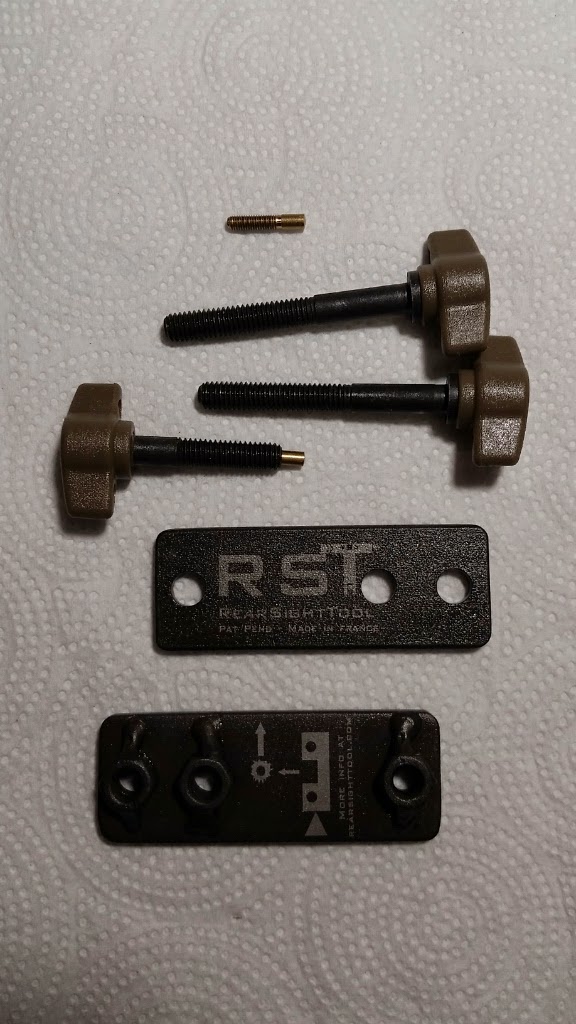
I finally swapped out the Burris red dot sight on my G20 non-compensated slide for a set of TruGlo fiber optic sights. I got a compact sight pusher tool from RST. It's a simple & clever "I could have made that" design but I didn't have to.


The pusher consists of two steel plates, both with holes and one with nuts welded in front of them. There are two long thumbscrews for clamping the slide between the plates and a shorter one with an interchangeable tip that does the actually pushing work.

Clamping the pusher to the slide is pretty trivial, beyond aligning the pusher screw to hit the sight but not the slide.


The base plate of the Burris sight is only slightly narrower than the slide, so all this pusher could do was pop it loose and start it moving. I put the slide in a vise and tapped the sight the rest of the way out with a handy deadblow hammer, which was bigger than needed. I have no doubt that I could have completed the removal without the vise if required.

Installing the new sight was pretty much exactly the reverse of removing the old. I had to tap the new sight far enough into the dovetail for the RST pusher plate to be able to clamp to the slide, then the pusher very easily and precisely moved it into place.


The slide had a Trijicon front sight in place. It was very easy to remove and replace with the red fiber optic TruGlo.


That pic was deceptively hard to get. The focus depth of field on my smartphone is narrow enough that I had to hold it almost at the limit of my reach for front and rear sight to both be in focus. Since I needed to crop most of the pic, I had to turn the resolution up to max. Pretty happy with it, actually.

The one complaint about the RST was something I might have been able to avoid, but the soft brass pusher tip left brassy colored scuff dots on the black finish on both sights. This is mostly removable, but particularly on the Burris plate, cleaning the brass dot off left a slightly polished finish. I think that is because the Burris plate has a paint/powdercoat finish and the TruGlo is some sort of chemical finish like anodizing.

The tool comes with a spare brass point and a steel point. The steel point may have actually been better for not leaving these marks. If I need to adjust the TruGlo sight, I will test the steel point for that.


All in all, I am very pleased with the RST sight pusher tool. It was inexpensive and is small enough to leave in the range bag, particularly disassembled and kept in a plastic bag.

As of this writing, I have not yet fired the pistol with this slide and sight. One of the main reasons to have changed out the Burris sight is that it is not IDPA legal. By putting the notch and post on the non-compensated slide and changing the slide release back to stock, this pistol we be IDPA legal in the SSP division, though only in 10mm Auto. If only there was some technology to make soft shooting 10mm rounds...

Speaking of ammo, we recently had an IDPA classifier match where some old ammo problems I thought I had address came back for me, resulting in quite a bit of lost time clearing failure to feeds. As a Marksman shooter, I scored firmly in Novice territory. To my credit, I did not accrue any ammo-jockying procedural errors, even when it was all jammy during an advance or retreat.

I was using some 165g RNFP loads with Ranier Ballistics plated bullets that I had gotten from Cabelas. Once I started having troubles, I unloaded all my magazines into a pocket in my range bag and grabbed a box of previously reliable 155g RNFP loads with Xtreme Bullets plated bullets. At first, I thought perhaps I had ammo that had not gone through my fairly rigorous QA process, but I have since found that all the rounds of both loads drop perfectly into the gauge block and that the OAL of both loads is the same. As it turns out, I am reasonably sure the OAL turns out to actually indicate the problem.


Left to right: 165g Ranier, 165g Xtreme, 180g PMC factory, 180g Remington factory.

If you look closely, you will see that the flat point profile of the Ranier bullet is significantly smaller than the flat profile of the others, leading to a more acute angle for the cartridge to contact the feed ramp during feeding. I don't have a stock Glock barrel to compare it to, but the LoneWolf conversion barrel in the Glock 20 will frequently fail to feed these rounds that are otherwise drop-in happy. In a quick and non-scientific test of cycling a few magazines of this ammo manually through two pistols, the Ranier bullet loads failed to feed about half the time in the Glock with a 40S&W conversion barrel, but only once in the native 40S&W Kahr CW40. The other three examples did not fail to feed even once.

Long story short, the OAL length for the Ranier bullets needs to be longer than for the Xtreme bullets. It's that pesky ogive impingement angle. The overall length is a critical measurement, but really it's not the actual end to end length that matters so much as the base of cartridge to the circle/point on the bullet that first contacts the feed ramp.

The longer part of the story is that, while I might be able to slightly extract these bullets and reseat them to the proper depth, the actual better way to do it would be to pull them all and reload them from scratch to the proper length, once that length is determined.

In other news, a coworker sold me his Wather P22 pistol. I had shot it a few times before he sold it, but I have not yet shot it as "mine".


He included a significant quantity of Federal, CCI and Aquila ammo, as well. I was able to find a leather Galco Stinger belt loop holster for it at Cabela's, in the Bargain Cave, but I don't particularly like that particular one. The holster fits tightly enough to the pistol and loosely enough to my belt to not draw nicely. I want it to be secure, but I don't want to struggle with it to draw. It's primary role will be to carry around the property and while fishing, ATVing or other outdoor activities. Some additional forming on the holster may help, but I will probably end up with a Kydex holster of some sort. CompTac makes one for it, the same model as I got for the Kahr.


Sunday, March 8, 2015

Some Overdue Customizing


Though it is a fairly common "mod", I had not taken the time to paint fill the imprinted lettering on my magazines and the slide of the pistol.


Pretty happy with the added contrast. It doesn't help it shoot any better, but it was a nice project that I could do in a couple of hours with a bonus of spending time with my Love in the craftroom.

As an aside, I noticed while doing this work that the screw holding the front sight is loose. It will be an easy enough fix, removing the screw and sight, cleaning with acetone and reassembling with Locktite.

There are many descriptions on the web as to the lettering procedure. In my case, I first cleaned the slide and magazines with acetone. Next, I used plain ol' Testors model white enamel and a size 0 detail round brush. Technically, I was globbing it on to fill all the lines, but I tried to keep the glob in the lines and the part outside the lines as thin as reasonably possible. I filled all the lettering except for #10, which I went back and did in red. I wish I'd had a brighter red, maybe a fluorescent red or orange, even green. The point is that #10 is also filled but in another color. In IDPA shooting, magazines in my divisions are typically loaded to 10 rounds and since I am corrected to slightly farsighted with my contact lenses, it is hard to make out even the higher contrast lettering to read the actual number. Making the 10 another color makes it easier to check the magazine capacity.

Once all the paint was well dried came the somewhat tedious bit. I used the Testors thinner on bits of paper towel. It took a couple of magazines to refine the technique, but what seemed to work well was to put a drop of thinner on a small piece of paper towel and quickly rub it over a small area of lettering, checking between each stroke. When only the desired coloring is left, buff the area with a dry paper towel. This was the fastest way and required the least retouching cleanup. The thinner needs to be really light on the towel. Too much on the towel and it wets the paint too much and too much is removed from the lettering. I did all the white then came back to the red with fresh towels to keep the white from becoming kind of pink.

I pretty pleased with how they turned out.


In a previous post, I noted that I had a magazine that did not easily drop clear at reload time. Since I had numbered the magazines, I knew which one it was. While I was preparing the magazines, I had them all in one place and wanted to compare this troublemaker with it's stablemates. I found a couple of differences that I am sure are documented online somewhere else, but here goes....

Since the empty magazine wasn't dropping well when released, I first wanted to compare the latching notch. It turns out that there was a pretty big difference immediately visible. The magazine on the right is the one that doesn't drop well.


In further digging, I noticed a difference in the followers as well. The one marked with a 2 is the one that doesn't drop well. Due to the shadow, it's hare to see, but the top magazine follower has a simple '10' on it while the bottom one has '10 mm' completely obscured by the shadow.


Referring back to the pic above of all the magazines, note that the two on the left are slightly different in the placement of the Glock logo. Yes, I have two magazines of this different model. In the original numbering order, these were magazines 0 and 2. The first was easy to remove from the magazine order. I did all other shooting with magazines 1, 2 and 3. However, I have so rarely had to drop mag #2 on the clock that I haven't noticed if it also had trouble dropping clear.

Partly to address this issue and partly because I just have them, I decided to install the six magazine extension floor plates that I got in the box of goodies that included, among other things, most of these magazines. The previous owner found that, with all other equipment on his pistol, these extension floor plates in stock condition made the overall weight of the pistol perilously close to overweight for IDPA. He drilled out some material from the inside of the plates to reduce the weight. I hope my combination of parts fits under the wire because the added weight to the magazine makes all six thus equipped drop out of the pistol nicely. I have put them on both of the 'odd' magazines for the acid test.

The pistol is a close but passing fit in the IDPA box with the extensions.


Friday, February 6, 2015

A Little Upswing


Well, I didn't get to attend the SO class. I will try harder to make the next one!

A few of my coworkers and I have begun a lunchtime range trip. Three Thursdays in a row have had us going to three different local ranges. For the last two, I have also attended IDPA matches that evening and I think it has helped. Last night's match was particularly gratifying. I like all those 0's and 1's. In fact, there was a single 3 and all other targets were 0's and 1's. Oh, and one procedural for taking a step when I was supposed to be flat footed for those targets. I didn't even know I did it. :)


At yesterday's shooty lunch, I was was shooting hot ammo. Power Pistol handloaded 40's and some bulk 10mm I bought some time ago that are pretty peppery. I need to chrono those someday. Then for the match, I was back to my usual semi-mild 155/165 grain TiteGroup loads. While I didn't specifically train with big ammo and shoot with lighter, that's how it worked out. It was quite a confidence booster.

At the match, I had one magazine that didn't drop free very well. Because I only yesterday numbered my magazines with some skate tape stickers from Dawson Precision and I kept track of which ones I was using last night, I know which one it was. I will see what I can figure out, but I suspect it will be a slight burr on the notch where the magazine engages the release.

Having loaded up a good inventory of IDPA ammo, I took time to inventory my reloading components and find that I am in pretty decent shape there. Since I am consuming more 40S&W than anything else, it makes sense to have some extra for components needed for 40. I was gifted with a big heavy bag of 40S&W brass. I haven't weighed it, but I imagine its in the 10 pound range, which puts it at about 1000 rounds. Add that to the stock I already had and I should be able to practice enough to help. :)

Speaking of practice and chronographing... Begining at about 2:40 into this Jerry Miculek video about a cool shotgun speedloader (interesting in its own right), I noticed a piece of equipment in the background. It seems obvious to me *now* but it had simply not occurred to me that a bullet trap could be sized to be mounted on a trailer. In my mind, a bullet trap small enough to be portable was just a safe area tool and all others were part of a permanent structure, typically an indoor shooting range. Now I want one.

I see a small unit with a 24" square opening as adequate to my most common need, a safe place to chrono handloads and otherwise test firearms. Other than a lotto win purchase, I think I'll have to just keep my eyes open for something for sale or make one.


Tuesday, January 20, 2015

Still Shootin'


I haven't updated the ol' blog in a while, but I have still been shooting!

The intervening time included one major match, a bunch of local matches and a couple of months fighting off a return of my childhood nemesis, asthma.

Asthmatically speaking, it's now well controlled. I'm essentially symptom free once we found the right combination of treatments, which turned out to be Singulair, Breo Ellipta, albuterol and occasional Allegra for good measure. Once I was able to get it under control with medication, I have been able to wean completely off the medication once more.

I haven't stopped tracking all my matches, but I have stopped deeply analyzing bad stages. A tip from With Winning In Mind is to make note of bad stages and their general causes, but to not exhaustively analyze them as I have been. That actually reinforces bad behaviors by dedicating a lot of mind-space to them.

As I have begun looking at stages that way, I have also realized that, while the actual details may vary, the root cause of.... I'm going to go out on a limb and say probably all.... of my bad stages is....  prepare yourself for this nugget of wisdom.... not doing everything right.

What looks like a quote from Captain Obvious is more subtle than it seems. Obviously, I didn't do everything right or I would not have scored badly on the stage in question. But the subtle bit is that rather than agonize over what I did *wrong*, I need to add to what I did right.

I have cranked out a lot of ammo lately, about 2000 rounds of 40 S&W, split between 155 and 165 grain bullets. 155/165 grain bullets on 4.5 grains of TiteGroup has become my routine ammo. It makes about 140 power factor from the Glock, so it should make better than 125 even in the Kahr.

My press issues have all been addressed, as have the quality assurance issues. I have not had a single ammo issue since before June of 2014. I like having a sizable inventory because I can just go shoot without being overly concerned with whether I have suitable ammo.

I *have* had troubles with misfeeds that seem clearly to be caused by a limp wrist when shooting weak hand. At least two matches in the last couple of months featured a course of fire requiring shots fired weak hand only and on both occasions, I had ammo feed problems with the weak hand only element and full reliability with all other shooting. Reliability, not necessarily decent scoring :)

This weekend, I am taking the IDPA SO course. I've been with IDPA for over a year, shooting almost every week, so no excuses not to take on a little more responsibility.


Tuesday, August 12, 2014

Toybox

A local club member sold his Glock 21 some time back, but he still had quite a few accessories for it. Long story short, we cut a deal...

Since the Glock 20 and Glock 21 use the same polymer frame, the top ends and magazines are interchangeable. Consequently, one can have a 45 or a 10mm just by changing out the top end and magazines. By extension, they could also shoot whatever conversion barrels are available for either upper.

My friend had a stock Glock 20 slide and barrel with a nice Burris Fast Fire III sight installed, and a Lone Wolf stainless steel long slide 45 Auto with a compensator and ghost ring sights. There were also five 10mm magazines, aluminum magazine baseplates, two holsters and two mag pouches.

Here is my frame with each slide installed. Using a flashlight to prop the pistol up. Sorry for the dim lighting.


Add caption
I have not yet fired either, and to fire the 45, I will need to procure magazines.

As they currently are, neither is IDPA legal. Both specific sights and the compensator are excluded.
My plan, however, is to swap the sights between my Glock 20C and this Clock 20 slide. My TruGlo TFO sights on the non-compensated slide and stock 10mm barrel may allow me to classify and shoot SSP with that pistol (although the extended slide release may be excluded) and ESP with the 40S&W conversion barrel. 

The 45 may or may not be too long even without the compensator installed :)

Modern Problems


I have used enough of these CCI shotshells lately that I needed to get some more.

I checked Cabela's and Academy, no luck. The last ones I got from MidwayUSA online, but they were out of stock, too.

Found a place, Alamo Ammo, in San Antonio. They had them in stock and they are in the state, next best thing to buying local. I ordered two boxes in 40S&W and for the sake of completeness, two in 45 Auto.

In the order process, I discovered that, without some paperwork hoop-jumping, they will only ship to the same address as the billing address of the credit card used. Mildly inconvenient, as this usually results in an extra day as a delivery attempt is made at home, a door tag left, signed and delivery made the next day.

The FedEx guy calls me Thursday night, during the match. I call him back when I'm free and in short, discover that the shipper requires an adult signature and he has to witness the signature. We discuss that it's unlikely that I can be home at any time in his delivery schedule without taking time off work, so he suggests I request that it be held at the depot in Fort Worth so I can pick it up in person there.

I do that, arranged via the tracking website and found that it can be held for pickup not only at some depot but at other FedEx facilities. I have it sent to the nearby FedEx Office store on Camp Bowie.

After work yesterday, I go down there and after great effort on the part of the girl at the counter, the difficulty comes clear. The original driver needed an adult signature because the package is marked ORM-D. They can't accept ORM-D shipments at a FedEx Office store, so it was probably refused and went back to that driver's depot. The ugly bit is that the computer said only that it was held at a FedEx Worldship facility, but not which FedEx Worldship facility.

It was decided that customer service had likely sent her call to a facility that probably closed at 5PM, so for the best results, I should call during regular business hours. I just did that. I have an address and it closes at 5. Hopefully, I can sneak out a bit early and get it today, for tomorrow is the last day before it gets returned to the original shipper.

So....

If I plan to order anything else from Alamo Ammo, maybe I need to fill out that paperwork so they can ship to where I am during the day.

Friday, June 27, 2014

Slow Updates

Forgive me, internet. It has been 21 days since my last post....

Actually, things have been a little bit pokey on the shooting front since State.

During this time, I have attended only one match, but I scored pretty well. I really only had one stage that gave me any grief, a stage where all shots were weak hand only. It was a 6 round stage that took 11 rounds to score 8 down. All other shots on all stages were 0's and 1's, which is starting to be the case more and more often.

I have loaded a lot of ammo and the spring mod on my press has worked perfectly through about 500 rounds with no signs of failing.

Powder is beginning to stay on store shelves for more than the length of a Two Stupid Dogs cartoon. Selection is still not impressive, but it's way better than none.

Only peripherally related, I have dispatched a few particularly aggressive snakes. I really try to chase them off first. A rock tossed directly at them or bit of fishing rod whipping is usually enough to make them flee, but if they keep coming back directly at us without keeping a respectful distance, like sands though their hourglass, their days run out. Abruptly. CCI shot shells in my Kahr CW40 work really well. More shot and more power behind it than the 22LR shot loads and a non-heirloom pistol that is easier to carry to the lake. It's a bit loud, though.

The thing that has consumed most of my free time for the last couple of weeks is not shooting related at all. ARRL Field Day is an annual amateur radio contest that I enjoy participating in. The object is essentially to practice extended emergency operations, to make as many contacts in a 24 hour period as possible, but with your station operating in varying degrees of emergency configuration. There are various classes of station ranging from large but completely portable and self-sufficient operations set up no more than 3 hours before the contest begins to folks just operating from their regular setup in their den, with many scoring weights and multipliers in between.

In 2012, I set up a nice permanent vertical antenna and had some friends out. We set up a second temporary antenna and operated a 2E station, two transmitters in a permanent station location, but with power provided by emergency means, in this case a generator. In 2013, I had a scheduling conflict and could not participate.

Then last winter, in an escaped horse recovery incident, I ran over my antenna with my truck. I mowed that thing down. The damage was actually fairly minor, considering. I got two replacement parts and over the last couple of weeks, I have erected the antenna once more!


So, beginning at 28 June 1800 UTC , I will be seeing who can hear me...

Friday, June 6, 2014

Minor Press Update


One bit of the design of the Lee Pro1000 press that is both clever and a little cheap is the use of a length of ball chain to return the powder measure at the bottom of each stroke. The ball chain works very well in this role., but it is not particularly durable. Mine has broken enough times that it is now too short to use.

Some time ago, I predicted that the chain would eventually be too short and purchased some hardware to replace it with a length of 1/16" steel cable. Due to one of my other hobbies, I generally have a supply such cable laying around.

Last night, the chain broke and, as expected, it was too short to use again. Unexpectedly, however, I could not locate my stash of cable. I was able to work around it to good effect, though it was by using the ball chain again.

The Lee design uses a compression spring to give the return mechanism a positive return, yet some mechanical compliance. Personally, I think this spring is too strong and leads to the failure of the chain. I have contemplated replacing it with a lighter spring, but I think the use of an extension spring instead might prove better still.

My workaround was to mix the leftover ball chain with a new extension spring. The length of the assembly just extends the spring, but it appeared to always retract the powder measure as needed.


It still works basically the same way, but the new spring should put substantially less load on the chain. The spring is rated at just under one pound working load.

I loaded 100 rounds this morning without incident. At least without a powder measuring incident. :)


Thursday, May 29, 2014

CompTac Texas State IDPA Championship (and ammo talk)


1. I had a great time!
2. I shot ok, but scored poorly (and yes, that is possible)
3. I had a great time!

I was up early and on the road a tiny bit later than hoped, but still in plenty of time. Signed in, got my score sheets and promptly stuck the barcode labels in the wrong spot. Oh, well. I had fun with it and it doesn't appear to have actually hurt me :)

The match started pretty much on time and my squad started at Stage 8. Between "first stage" jitters and the general weirdness of the stage itself, comprised of three arrays of targets at different tactical sequence ranges, many with partial hard cover and a swinger directly in front of the seated shooter, it was not my best score ever. The SO warned us that it had generated a lot of FTNs and sure enough I had one on that stage; not the last of the day, I might add. At least I got the pressure of achieving a zero down match out of the way early.

After a bit of a lukewarm start, the rest of my shooting was not bad. Lots of 0's and 1's, a few 3's, and occasional honest misses. By the term "honest miss", I mean a miss when engaging a target. The pain point of my performance was a couple of stages where I failed even to engage some targets.

The worst of these was Stage 5. As the first shooter on this stage, I did not have the benefit of seeing others' plans and my own relative inexperience lead me to skip two targets. For the steel, that's 5 down plus an FTN plus a procedural for not shooting in sequence, and for the paper, 10 down plus FTN plus procedural. The rest of the stage was 0's and 1's.

Stage 10 was one where poor planning resulted in running out of ammo at a critical point. There were two disappearing targets triggered by falling steel. The first went well. Drop the steel, it triggers the paper target, which turns to expose then turns back to hide. The shooter has about one second to place two rounds on it. Proceeding to the second one, I dropped the steel, fired one at the paper and... slide lock. My one shot missed, so 10 down. At least there is no FTN on a disappearing target. In my defense, at least one shooter slide locked dropping the steel and had no shots for the target itself. The better plan for me would have been to drop the first steel then shoot to slide lock at the first target, which would have been four rounds. Reload, drop steel then take at least three shots at the second paper. Next time.

Stage 2 was a fairly average score, but due to some taping logistics, I got a free 0 out of a disappearing target. When triggered by a falling steel target, it raises straight up, which causes it to drop it's counterweight, which makes it again fall out of sight. John S and I were the main people resetting and taping this target, but it turned out we were adjacent in the shooting order. I taped and reset the target when John was on deck, but when I was on deck, John was following the SO counting his own scores. Someone reset the target but nobody tapee it. When we counted my scores, there were three 0's and a 1. The SO elected to give me a 0 on it. I checked with John and he gotten a 0 on it, which means the single 1 was actually mine. So, tiny bonus!

The painful bit was my overall score. My total raw time was 433.79, which itself would be just below the center of the pack in my class & division. However, 162 points down, 2 Non-Threats, 4 Procedural Errors and 3 Fail to Neutralize tacked on another 118 seconds, for a total of 551.79, placing me third.... from the bottom. Really, next to the bottom. The very bottom shooter did not finish.

The other bad stat, which also doesn't account for the fact that I got 0 or 1 down on 78 of the 106 targets is "Least Accurate". Understandably, however, 162 points down is still 162 points down. I was number 228 of 234 shooters on that list. Ouch.

I was slightly rushed when editing, so the video is pretty basic. I started at Stage 8, and the stages were shot in an offset sequence, but they are presented in stage order here. Stages 2 and 3 are missing because I didn't start the camera correctly (if at all) before those two stages. The memory card on the camera filled up while we were scoring Stage 7, my last for the day.

I just barely broke into my 6th box of ammo, using just over 250. That would include about a dozen unrecovered live rounds cleared at the end of the stages, so I shot a pretty solid 230+ rounds. I thought I had no ammo troubles, but in putting the video together, I found a failure to go into battery in Stage 7 that I had cleared quickly and forgotten. The first magazine was downloaded to 6 rounds. I emptied that one, changed magazines, fired one shot and that second round did not go into battery. I probably should have bumped it in, but I racked it out instead. That was the only one for the whole match.

In the chronograph stage (also not on video because it wasn't me shooting), my ammo performed well, too. I used load data from various sources to arrive at my particular load, 4.5 grains of Titegroup pushing a 165 grain RNFP plated bullet from Rainier Ballistics. I had not clocked them myself, but I predicted about 950 FPS. The official chrono rounds were 968, 933 & 986, for an average of 962, power factor 158.

Titegroup is reputed for burning pretty clean, especially at higher pressure loads. After the match on Saturday, the muzzle of the pistol had a tan colored deposit. It reminds me of the color deposited on the spark plug of a well tuned engine. Maybe there is a correlation; maybe a 165 grain bullet sitting on 4.5 grains of Titegroup approaches stoichometric.


Speaking of ammo, I have just started using some Tula small primers that I acquired in a group buy back in December. I have found that they seem to feed better than the Winchester WSPs that I have been using for a while. After a little analysis, I think there are two reasons. First, they appear to be smoother or maybe plated. While it's not a lot of friction, less is usually better. Also, the Tula primers are heavier by about 0.5 grains each. Since there is a column of primers in the chute, a half grain times about 20 primers in the chute is about a half a gram more gravity at work. That doesn't sound like much, but for the smooth flow of primers down a plastic chute, it may be enough to make a difference.


Here is a Tula KVB-9 on the left and a Winchester WSP on the right.


The cup is slightly thicker on the Tula, which probably accounts for some of the weight difference and may also explain the occasional complaint of light strike misfires on Tula primers. The anvil is of a slightly different design and is likely made from the same gauge of brass.

I don't care for the plastic tray that the Tula primers come in. It appears to be designed to flip the primers anvil side up while in the trays. However, I need them to be anvil side up once transferred to the primer tray on the press. So far, I have not found a reliable way to turn them. I have gotten close by placing a plate over them, flipping the whole assembly, pushing them into a small bundle, then covering the bundle with the primer tray and flipping that back. Because of the dimension of the plate and tray, the primers either drop a couple of millimeters and bounce or turn maybe even fall out. I will figure out something.

Friday, May 23, 2014

Tick Tock Tick Tock


Counting down the hours to my first really big match, Comp-Tac's Republic of Texas State IDPA Championship Match. There will be 250 shooters on twelve stages and a quick glance through the match booklet shows most are 17-18 round stages totaling over 200 rounds. Lotsa bang-bang.

To that end, I seem to have (most likely) solved the occasional failure to go into battery that I had at the last local match. Those rounds were a little short in OAL, 1.118 to 1.122 from a sample of 5 kinda random cartridges from each of three boxes. I experimented with the gauge block and to some degree with the chamber on my Lone Wolf barrel and round that 1.130 - 1.135 was about the maximum OAL that would drop freely into and out of the gauge block. The chamber in the barrel is even a little more forgiving. I have not had the opportunity to fire any of them (and probably wont get a chance before the match) but I hand cycled 45 rounds through the pistol without a single failure to go into battery or jam. We'll see, but I am cautiously optimistic.

In loading up for this match, I wanted to ensure I had the least opportunity for ammo related failure, so I would load up my output box full, gauge them all and set aside any rounds that didn't gauge the first time through. Most of the time, out of the 70 or so cases that the press can hold at one sitting, 40 or so would gauge the first time. Of the remaining 30, almost all stuck on a case bulge and could be fixed by running through the Bulge Buster. The remaining few turned out to be a little long, 1.140 to 1.150. Running singly through the seating and crimping died fixed most of these. Seems like there would usually be one or two that none of the above would address, but those cartridges are noticeably... lumpy. Not really deformed, but not smooth either. Maybe the wall of the brass is too thick or maybe not cleaned well enough. Maybe they were over length and the crimping step buckled them. Maybe those particular bullets are oversize. In any case, I have a special box for plinking rounds. They should not be dangerous, but they might have feeding problems, so I don't want them to land in a box of ammo for a match.

There was one trend that was hard to ignore. A noticeable percentage of cartridges that fell through all the correction procedure and ended up in the plinker box are headstamped Geco. I didn't really analyze whether there were also a lot of Geco cases that passed, but I did notice a lot in the fails.


When I am less rushed, I will dig through the brass and compare these to others to see if I can find a common issue.

Using this QA procedure, I loaded up 300 rounds of what should be reliable ammo. They are Rainier 165 grain Round Nose Flat Point bullets over 4.5 grains of Titegroup in mixed previously fired brass. I have not chrono'd this, but I expect it to be around 950 FPS and 155 power factor. This is the same load I shot at the last local match and except for the couple of issues with rounds not going fully into battery, they performed well. The pistol is pretty clean, with only an inch or so of light smudging at the muzzle and a remarkably clean chamber and ejection port.

I finally bought a proper concealment vest, a Rothco Plainclothes, in basic black. These types of vest conceal your weapon well, but they are not called "shoot me first" vests for no reason. They hide the weapon but they also scream "I'm hiding a weapon". Or maybe it screams "I'm hiding 19 rolls of film, 3 cameras, two tripods and a portable darkroom". In any case, I don't think it will see much street use for me. With 7 pockets inside and 16 (!) outside, I can picture the last few seconds of my life looking like I'm picking fire ants off me while searching for the particular pocket I put whatever that thing was into. In any case, it's comfortable and it hangs and swings well for drawing and holstering, and that is why I needed one. Maybe it will help the SOs be less nervous when I reholster at the end of a stage because my Dickies shirt cover can be flimsy.

On the airsoft front, WalMart supplied a couple of useful trinkets.

First, I got a cute yet useful target. It's a gel coated target that does a good job of capturing the BBs. It's has an artists rendering of an armed zombie-like creature, done in realistic nuclear green, but otherwise, it's a good way to keep those BBs from going everywhere when I am doing various drills. One drill I like to do is draw, fire once, drop and reinsert the mag and fire again. This target gives me something less general to shoot at *and* lets me easily recover the BBs to shoot again. Plus, you don't step on them later.

The other thing, and I've actually had this for a couple of months but have been doing dryfire drills and didn't need projectiles, is this speed loader from Crossman. You fill this plastic injector thing with 6mm BBs, depress the magazine follower and inject BBs into the magazine a few (6-8) at a time. Three or four depressions of the plunger and the mag is filled. Reloading a magazine takes 5 seconds instead of a minute or two. Construction is kinda flimsy, but adequate if you get the angle just right and don't force the plunger.

Friday, May 16, 2014

Sir Jitter of Stimula


Caffeine.

I have enough bad habits and few enough rounds downrange that I don't need to pile on The Folger's Thumps.

Even with my difficulties in printing a good score, the stages were fun. There was a mix of moving and staying aware of your cover with challenging standard stages, made all the more challenging by the shakes. Lunch was light and coffee seemed yummy in the afternoon, but by match time, it was in full effect.

There was a consistency in the score sheet. Points down and penalties added 8.5 to 10 seconds to every stage.


I must admit, I don't remember what my procedural error was on Stage 1. I definitely remember that Stage 2 was the only stage without one...

In stage 3, I had one procedural and one bad idea. You start seated in cover behind a barrel. Three targets, two each in tactical sequence. Move way back to P2, behind cover at a long hallway, two rounds on one target. Most shooters (the good ones, I might quip) continued down the hall to take a target to the left, then two more to the right. *My* plan was to avoid the easier breach of cover and take those last targets from the farther hallway. It was doable and had the potential of not harming my raw time. Where it was bad was that I took the first long target from cover, moved to the other hall and took one target, reloaded, then went down the hall. The first target to come into view was the one I had already engaged, but I stopped and gave it two more anyway. To add that extra little something, I had one miss each on the last two targets. My PE was failure to take the first three targets in tactical sequence. Moments before the timer started, I verified with the safety officer that they were to be taken in tactical sequence. Timer goes off, two rounds in the first target.

Stage 4 suffered a similar fate. The description was from P1, two shots each target, tactical sequence, freestyle. Reload, advance to P2, two shots each target, tactical sequence, strong hand. Reload, advance to P3, two shots each target, tactical sequence, weak hand. Limited Vickers count. First rattle out of the box, I had a round fail to go into battery. I cleared that round and continued, but in that confusion, broke tactical sequence. Due to the lost round, I had to reload early for the last shot from P1. That obviously meant I needed to reload early from P2 as well. Somewhere in that reloading fiasco, I took an extra shot at one of the targets. Since I also had a miss on that target and the penalty for exceeding round count is to have the best scoring round dropped, I lost a zero and gained a miss.

I had the GoPro but operating it apparently suffered similarly from my mental compromises and I only captured stages two and three, presented here in reverse order. I guess I still have some chemicals in my system.


I failed to mention that the ammo issue above was not the only one, but it was the only one to interfere with the match. I had trouble a couple times at load and make ready. The SO suggested they might be seated short. It occurs to me that must exactly be it. The seating and crimping die on my press was set the 165g RNFP bullets that I had originally gotten from Xtreme Bullets. When I loaded a batch of BBI's, they were pretty much identical in profile, so very little adjustment was needed. However, what I was shooting last night are plated bullets from Rainier Ballistics. Their RNFP profile is slightly different, closer to RN than the other two.

This is a catalog picture of the Xtreme bullet:


... and this is the Rainier:

Compare the ogive of the two. Though they are of the same nominal weight, the Ranier is slightly longer and has a slightly more acute ogive. The longer bullet means that it gets seated deeper in the case and the sharper angle presents differently to the ramp.

This picture, borrowed from another blog about the affect of bullet profile on rifling engagement, also shows the effect of the ogive and seating depth on the overall shape of the cartridge and THAT can cause chambering problems.


So, this morning I measured and compared a few rounds of both types and I discovered that the cartridges with the Ranier bullets were seated even deeper than just the bullet profile would explain. You may recall that I was having troubles getting cartridges with BBI bullets to gauge well. Some of them, due most likely to a thicker coating of polymer on the bullet, needed to be pushed a little deeper because they were engaging the rifling and jamming into battery. This was not as often a problem for actually shooting, but it frequently meant a jam clear at the end of a stage.

So, let me reiterate this again.... :)

Don't load a bunch of bullets until you have verified all the dimensions and that they will function smoothly and correctly in your pistol...

...especially with your first major match a week away...